Boundaries as an Act of Love – Holding Space for Myself and Others


For years, I wrestled with a contradiction. Spiritual teachings emphasize selflessness, surrender, and dissolving the ego. Psychological wisdom insists a healthy self requires strong boundaries to protect energy and maintain authentic relationships.
I've come to see these aren't opposites—they're interdependent. You can't fully surrender a self you haven't yet claimed. Boundaries aren't walls of separation; they're acts of love. When we set a clear limit, we're saying: "This is what I'm capable of right now. By honoring my capacity, I keep myself safe—and that keeps you safe too." Not rejection. Honesty. So the connection can be real and sustainable.
Without knowing our limits, we can erode ourselves through small, unexamined yeses—taking on what isn't ours, bleeding into roles that don't align. Resentment eventually surfaces, poisoning more than any clear "no" ever could. Boundaries interrupt this cycle. They preserve authenticity so we can show up from fullness rather than emptiness.
What happens when boundaries clarify
In relationships where boundaries have been absent, introducing them often creates friction. People accustomed to endless availability, quick fixes, or emotional merging may push against the new edges. This pushback is natural—it's the system adjusting to a new equilibrium.
Some people adjust and recalibrate. They learn to respect limits, communicate their own needs more clearly, and meet in a more balanced way. The relationship deepens. Others disengage completely—the dynamic was sustained by the absence of boundaries, and when that changes, the fit dissolves. Both outcomes bring clarity.
There's also a quieter effect: when we live boundaries consistently, we model what healthy relating looks like. People around us often start setting healthier limits in their own relationships. Self-honoring becomes a permission slip.
The practice of holding boundaries well
What I've learned—both in my own journey and in supporting others—is that boundaries require presence. When we're not grounded, it's easy to lose sight of ourselves. We can slip into future-tripping about someone else's feelings, or unconsciously shift to fix and soothe. The collapse into old patterns happens when we've stopped attending to our own center. The work is recognizing this before it happens and building practices that keep us anchored.
When we're able to stay present, something different unfolds. We can observe an interaction without needing to control or resolve it. We listen to what's being said instead of jumping to answer. That spaciousness lets boundaries hold naturally.
But presence isn't something we achieve once and keep. It's something we return to, again and again. And the moments that most require our return—the moments when we're already slipping, already caught in the old pattern—are where the real practice lives.
The moments that matter most
A few years ago, in a conversation that taught me more than I expected—though I've changed the details here—I found myself in familiar territory.
Someone close to me was upset about something I'd done. My first instinct—honed over decades—was to explain, to justify, to make them feel better so I could feel better. Within minutes, I could feel myself disappearing into their version of events, losing the thread of my own experience. The old machinery was fully engaged: future-tripping about their feelings, shifting to soothe, already preparing the apology that would restore equilibrium.
Then I remembered something a mentor once said: You can't find your center while reaching for theirs.
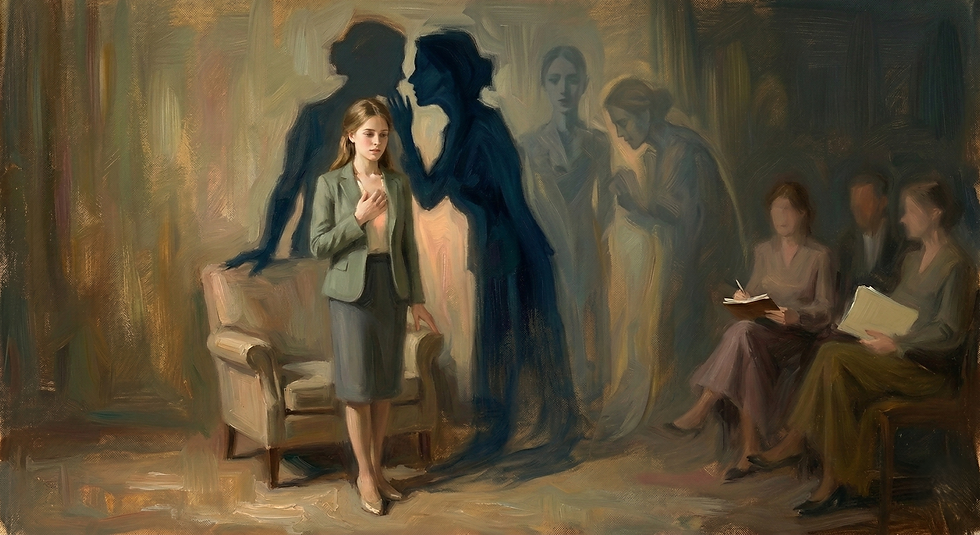
So I tried something small. I paused. Just one breath. Then I placed my hand on my belly—felt the rise and fall, the simple fact of my own body still here. And then, because I needed more, I said something I'd never said before: "I hear you. I need a moment to feel what I'm feeling. Can we come back to this in ten minutes?"
They were startled. So was I. But that pause, that grounding, that honest request—it changed the shape of the conversation. When we returned, I could hear them and hold myself. The boundary wasn't a wall. It was a doorway we both walked through.
Not every attempt lands that gracefully. Sometimes the pause comes too late. Sometimes the ground shifts under me anyway. But that moment taught me a rhythm I've come to trust when the old patterns pull:
Pause. Ground. Reconnect. I call it the Boundary Triad. The whole cycle takes seconds. And over time, those seconds build a new pathway—one where the witness stays online longer, where boundaries hold without effort, where the "oh shit" becomes oh, I know this moment. I know what to do.
Learning to hold this kind of presence—pausing, grounding, returning—has changed how I move through every level of my life. More on that another time.
When presence falters—when we're triggered, reactive, or already overextending—it's almost always because we haven't tended to ourselves. Tired, hungry, emotionally depleted: our capacity shrinks. External energies hit differently. Old responses can resurface. In those moments, the kindest choice is to recognize what's happening and disengage to restore. Self-care isn't optional; it's the foundation that keeps us present for others.
These micro-movements aren't about perfection. Sometimes the real intervention is simply noticing without self-flagellation: "This is happening. Awareness is here." Each catch, each return, rewires the pathway.
This journey isn't about building rigid defenses or achieving some enlightened state of no-ego. It's about cultivating the inner conditions for authentic presence: a sovereign self that can meet others from fullness, model mutual respect, and allow love to flow cleanly—without depletion or resentment.
Boundaries, held with intention and compassion, are love in action. They protect the sacred space within so it can be shared generously. And when we each honor our own limits, we create space for everyone to do the same. That, to me, feels like the deepest kind of interconnectedness.
Where have boundaries—or the lack of them—shown up in your life? How do you return to presence when old patterns pull? I'd love to hear.


Comments